

Angular Signals Evolution: Why Targeted Reactivity Beats Broad Zone.js Checks
A practical guide to why Angular signals changed the framework’s reactive model, how the UI responds differently, and where signal-era APIs fit across a real application.
After spending years with Angular, I think signals are one of the most important changes the framework has made.
This is not just because signals give us another state API. The real value is deeper than that. Signals change how Angular understands what changed, who depends on it, and which parts of the UI actually need work.
That is why I see signals as a genuine evolution beyond the old pattern of:
- an async event happens
Zone.jstells Angular something might have changed- Angular runs broad checks to stay safe
Signals move Angular toward a more reliable and more optimized model:
- state changes explicitly
- dependencies are known
- only the right consumers are updated
This post is about that shift.
What changed with Angular signals
In traditional Angular applications, the framework often leaned on Zone.js to detect when application activity happened. That model was productive, but it was also broad. It could wake much more of the application than a single UI change really needed.
Signals changed the conversation because Angular now has a built-in primitive for fine-grained reactive state.
The official signals guide describes signals as values that notify interested consumers when they change. The framework also tracks where signals are read so it can update more precisely.
That sounds small at first, but it changes a lot:
- state becomes explicit instead of indirectly inferred from async activity
- dependency tracking becomes part of the framework
- rendering can be more targeted
OnPushbecomes easier to work with- zoneless Angular becomes much more realistic
The main benefit: explicit and granular reactivity
If I had to explain the main benefit of signals in one sentence, I would say:
signals let Angular react to actual state dependencies instead of reacting broadly to the possibility that something changed
That is the key difference.
With older patterns, the framework often had to be conservative:
- a timer finished
- a click happened
- an HTTP request completed
- a promise resolved
Any of those could lead to another change detection run because Angular needed to stay correct.
With signals, Angular can be much more precise:
- this signal changed
- these computed values depend on it
- these templates read those values
- only those consumers need to be marked or refreshed
That is a better reactive contract.
Why signals feel more reliable than broad Zone.js-driven checks
One reason teams like signals is that the mental model is easier to trust.
In the old world, developers often had questions like:
- why did this component refresh?
- why did this event trigger another pass?
- why is a third-party library causing so many checks?
- why do I need
runOutsideAngular()here?
In the signal world, the reasoning gets clearer:
- what state changed?
- which computed values depend on it?
- which template reads those values?
That makes debugging and optimization more grounded in application state instead of framework side effects.
Signals vs traditional Zone.js-driven UI reaction
This is the comparison that matters most.
Traditional broad model
In a Zone-based application, Angular is notified after framework-visible activity. The framework then works to ensure the UI is consistent, often through broader checking behavior than the exact state change really required.
That works, but it can be noisy in larger applications.
Signal-driven model
In a signal-driven flow, the UI reacts because a tracked state source changed. Angular knows which consumers read that state and can target updates more precisely.
That is why signals feel more natural in performance-sensitive interfaces.
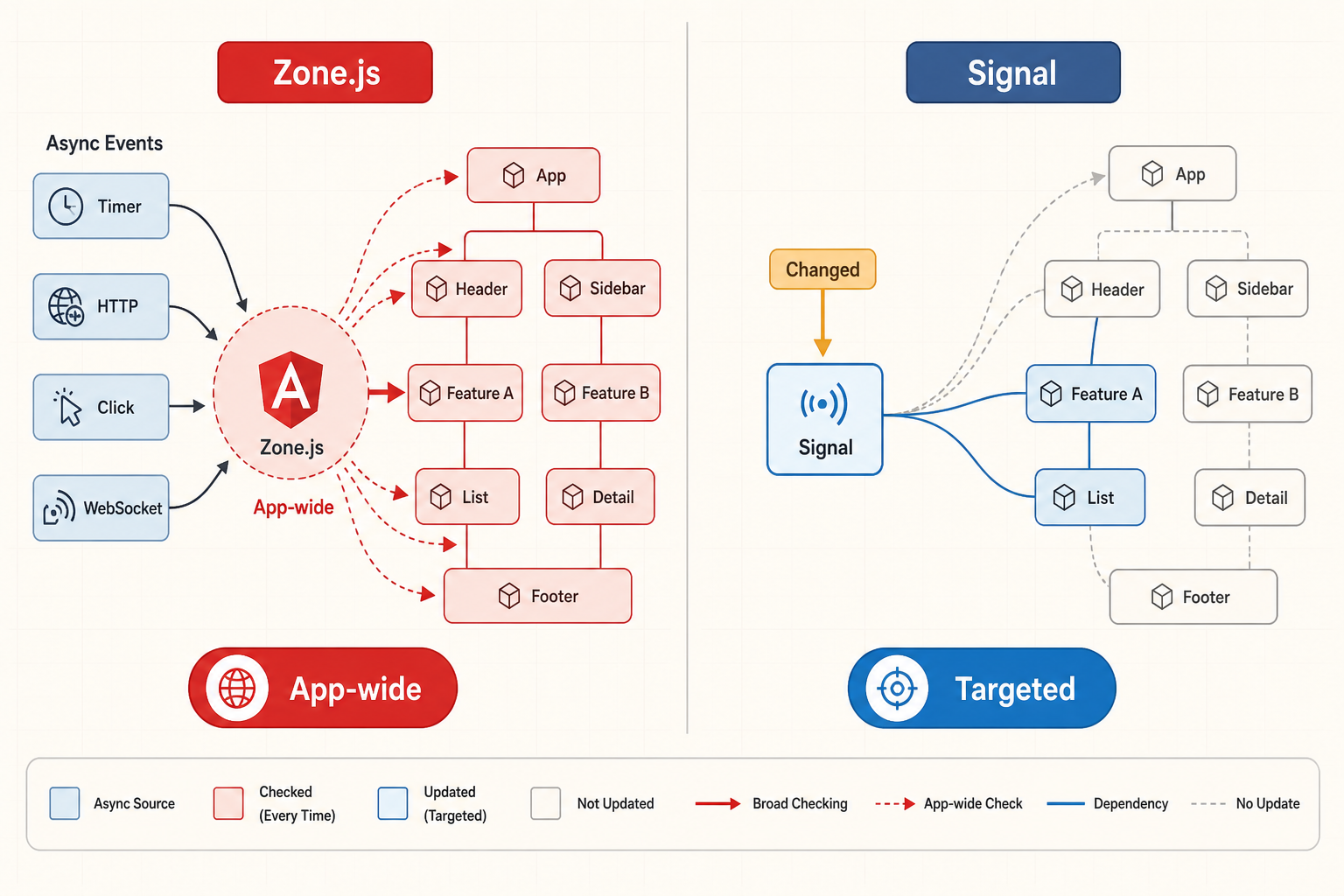
How the UI reacts with signals
Angular’s signals guide highlights two behaviors that matter a lot:
- Angular tracks signal reads in templates
- when those signals change, Angular can mark the right components
That means the template is no longer just a passive rendering layer. It also participates in dependency tracking.
In practice, the UI flow becomes:
- a writable signal changes
- any dependent
computed()values recalculate lazily when needed - Angular knows which template consumers depend on those reads
- only those parts of the interface need to update
This is a much more targeted reactive path than “something async happened somewhere.”
Why computed() matters just as much as signal()
Many developers first focus only on signal(), but computed() is where a lot of the optimization story becomes obvious.
computed() gives Angular and the application a formal place for derived state.
That helps because:
- derived values are declared once
- dependencies are tracked automatically
- recalculation only happens when those dependencies change
- unrelated branches stay untouched
This is one reason signals are more than a state setter. They create a dependency graph that Angular can reason about.
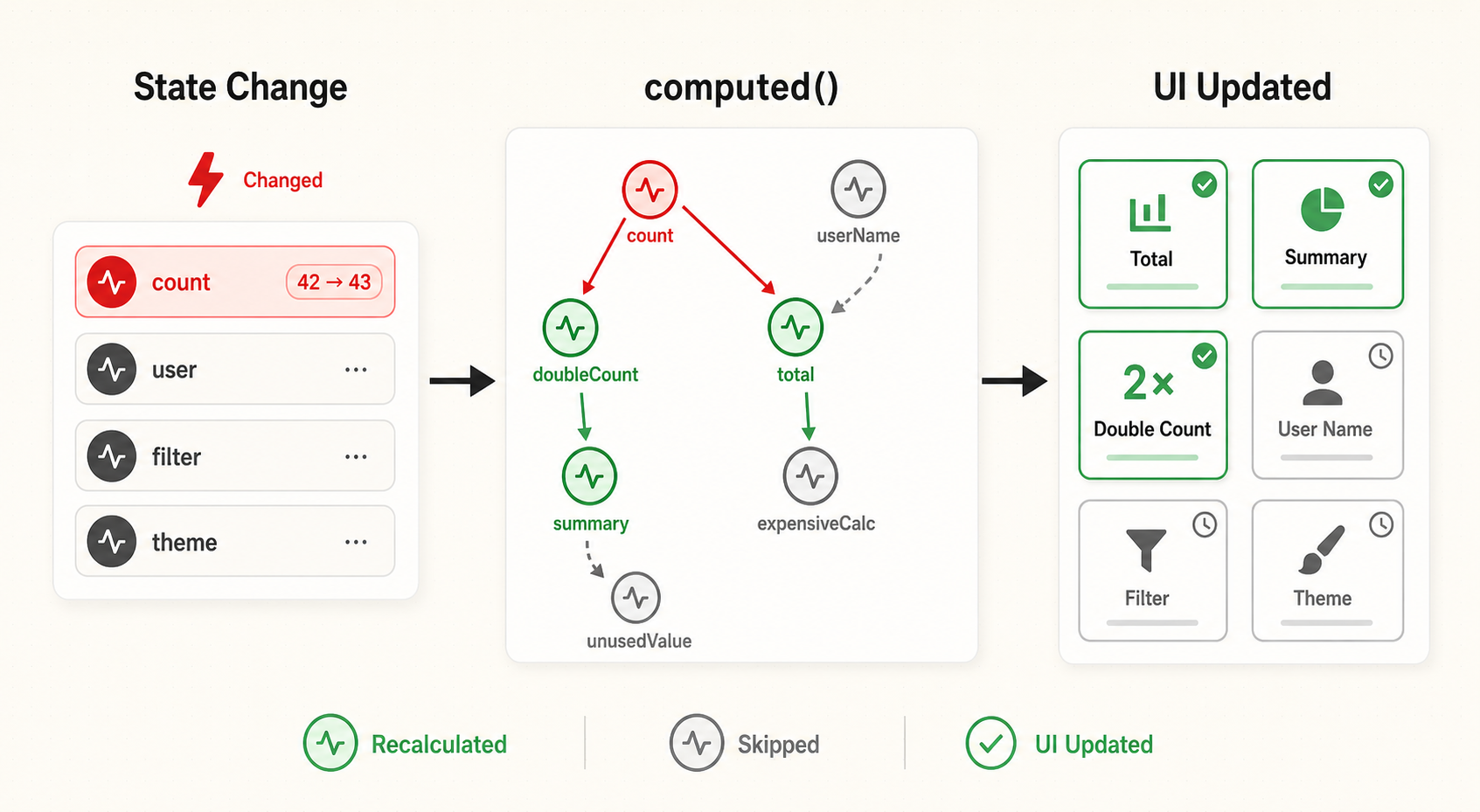
Where you can use signals and signal-era APIs in Angular
Another big reason signals matter is that the idea has spread across Angular’s authoring model.
This part needs one important clarification:
signal(),computed(), andeffect()are core signal primitives- APIs like
input(),model(),output(), andresource()belong to the broader signal-era Angular programming model - not all of them are literally the same primitive, but together they make Angular more explicit and reactive
That is what makes the evolution feel systemic rather than isolated.
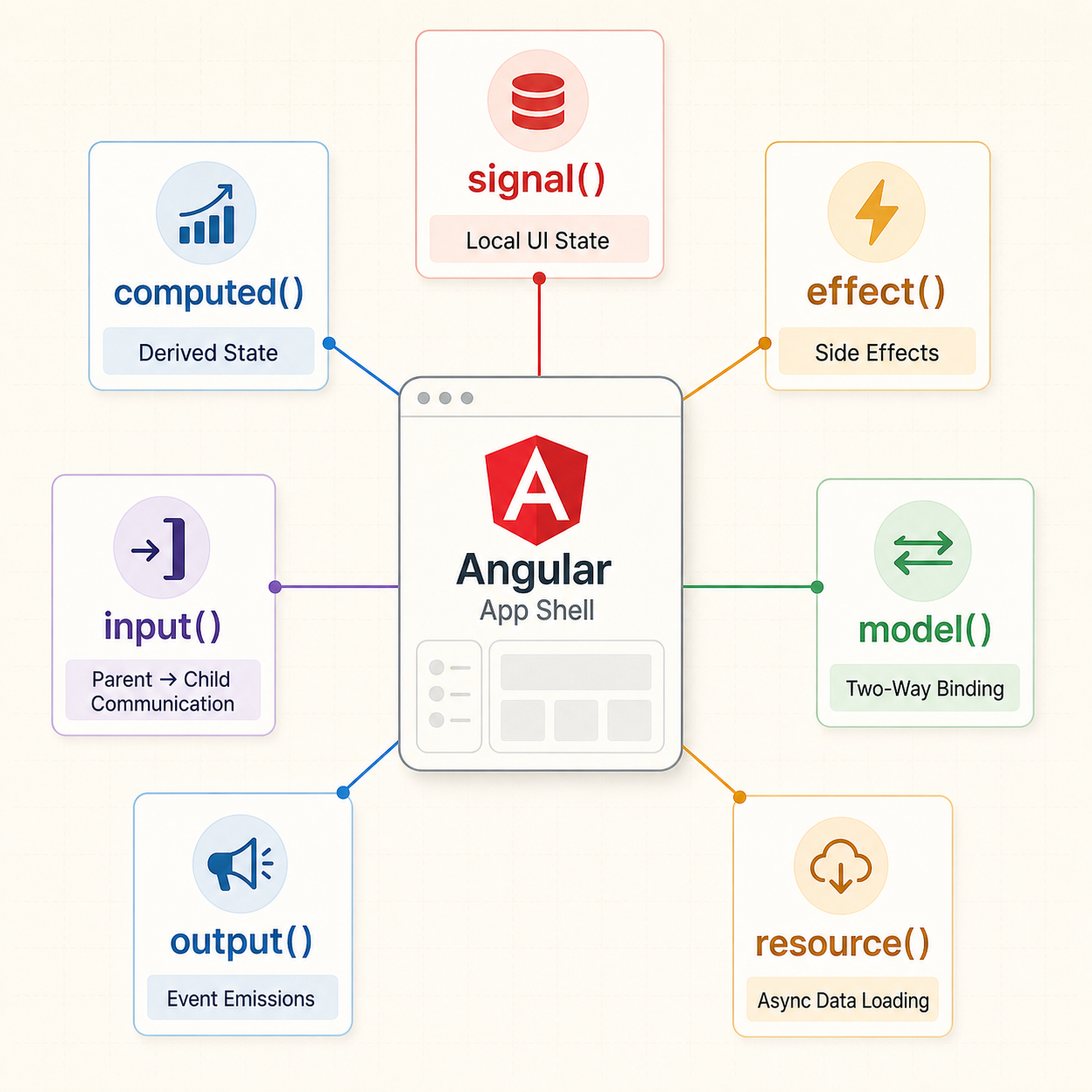
signal() for local UI state
This is the most direct use case.
Use signal() when a component owns state such as:
- current tab
- sidebar open or closed
- selected filter
- form wizard step
- temporary dashboard state
This works especially well because local UI state usually wants immediate clarity and targeted updates.
computed() for derived state
Use computed() when a value can be derived from other reactive state:
- filtered list counts
- visible totals
- validation summaries
- disabled or enabled button state
- selected-item view models
This reduces duplicated logic and keeps derivations consistent.
effect() for side effects
effect() is useful when state changes should trigger a side effect rather than only a template update.
Examples:
- sync something to local storage
- log analytics events
- trigger an imperative integration
- coordinate with non-template code
The key idea is that effect() should be used for actual side effects, not as a replacement for ordinary computed state.
input() for parent-to-child communication
The signal-era input() API improves component inputs by making them fit naturally into the same reactive model.
That is useful because:
- parent values remain explicit
- child components can consume them in a signal-friendly way
- derived state in the child becomes cleaner with
computed()
This feels much more cohesive than older patterns where reactive state and component inputs often lived in separate mental models.
model() for two-way state flows
model() is the signal-era answer for component state that participates in two-way binding.
This is valuable for reusable components like:
- form controls
- toggles
- search boxes
- selection widgets
It gives Angular a clearer contract for state flowing both into and out of a component.
output() in the new authoring style
output() is not itself a signal, but it belongs to the same overall shift toward explicit component APIs.
It helps event communication stay:
- typed
- intentional
- aligned with the newer Angular authoring style
This matters because signals become even more effective when the component API around them is also explicit.
resource() for async data loading
resource() is part of the newer Angular story for reactive async data loading.
Conceptually, it is important because it brings data fetching closer to the same dependency-driven worldview:
- inputs or parameters change
- the resource responds to that change
- consuming UI stays aligned with reactive state
This is a very Angular-native direction for async work compared with stitching everything together through manual subscriptions and app-wide checks.
How signals optimize the application more
Signals improve application optimization in several layers, not just one.
1. Fewer unnecessary updates
The most obvious win is that unrelated parts of the UI do not need to wake up just because some async activity occurred elsewhere.
2. Better memoization through computed()
Derived values can be recalculated only when their dependencies change, instead of being recomputed indirectly during broad template evaluation patterns.
3. Cleaner OnPush usage
Angular’s docs explain that reading a signal in an OnPush template lets Angular track that dependency and mark the component when the signal changes.
That means signals and OnPush reinforce each other.
4. Less dependence on Zone.js for correctness
The more Angular can rely on explicit state and dependency tracking, the less it needs broad async patching to stay correct.
That is one of the reasons zoneless Angular became increasingly realistic.
5. More predictable performance work
When optimization discussions are tied to real state dependencies, performance tuning becomes less about defensive framework workarounds and more about application design.
A practical scenario
Imagine a dashboard with:
- a total count
- a filtered list
- a summary widget
- a profile card
- a theme toggle
If only the count signal changes, you want:
- the count-related computed values to update
- widgets depending on them to refresh
- the profile card and theme area to remain idle
That is exactly the kind of targeted behavior signals make much easier to express.
Why this is a better migration direction than staying fully Zone-centered
Signals do not force every team to rewrite everything immediately.
That is one of their strengths.
A practical migration path looks like this:
- keep existing Angular applications working
- introduce signals for local state first
- use
computed()for derived UI state - adopt
input()andmodel()in newer components - reduce broad change-detection pressure over time
- move toward zoneless architecture when the application is ready
That path is more realistic than trying to jump from legacy patterns directly into a fully transformed architecture in one release.
My takeaway after the last two Angular posts
If the previous post was about why broad app-wide checks became a limitation, this post is about the answer.
Signals matter because they help Angular move from:
- broad framework suspicion
- broad tree checking
- broad async wakeups
to:
- explicit state
- tracked dependencies
- targeted UI updates
That is why I believe signals are not just a new syntax feature. They are a more reliable and more optimized reactive foundation for modern Angular.
What comes next
The next step after this discussion is the full zoneless architecture conversation:
- how signal-first components behave without Zone.js
- what migration patterns feel safe in enterprise Angular apps
- where zoneless gives real wins and where teams still need caution
This signals post is the argument for why that next step makes sense.
Further reading
Official Angular docs worth reading alongside this article: